SEO, AEO, GEO: What’s Actually Changing
There’s still a very comfortable story the industry keeps repeating:
Do SEO well → rank on Google → get traffic → convert users.
And to be fair, that story is not wrong. It just stopped being complete a while ago. What is interesting is not that SEO stopped working, but that SEO is still behaving like a stable system while everything around it quietly changed shape.
The first misconception: Ranking is not the same as visibility anymore
This is probably the biggest mindset gap we see. People still treat “we rank” as the same thing as “we are visible.”
But modern SERPs do not behave like that anymore. Between AI-generated overviews, zero-click results, and modular SERP layouts, a ranking position is often just one possible exposure point, not the exposure itself.
And even inside Google Search, visibility is now fragmented. So you can “win SEO” and still lose attention. That used to be rare. Now it is normal.
SEO still works, but it is no longer the system
Let’s be very clear here: SEO is not dead. That is a lazy narrative.
It still controls crawl access, indexing, baseline discoverability, and long tail search capture. But it no longer controls the full distribution path.
The mistake people make is treating SEO like the operating system of the internet. It is not anymore. It is closer to an infrastructure layer inside a much larger system.
That larger system now includes AI assistants that answer directly, social platforms that surface intent before search, communities like Reddit that shape decisions early, and users who increasingly skip search entirely for certain tasks.
Search is still central. It is just no longer exclusive.
The deeper issue: SEO optimizes for documents, not answers
Traditional SEO thinking is still largely document-oriented. It assumes pages are the primary unit, keywords are the main signal, and backlinks are the authority layer. That made sense when search was fundamentally document retrieval.
However, we are increasingly moving toward answer retrieval systems, and those systems behave differently. They do not tolerate ambiguity in the same way, and they do not “rank pages” in a visible sense. They assemble responses.
That shift changes what matters. Now, search engines do not care much about things like repeating keywords or writing really long articles or getting traditional backlinks. Search engines care more about content that’s easy for people and AI systems to understand. They want content that’s clear, reliable, and easy to get information from. This information should be consistent when you look at the sources. Search engines want to be able to summarize the content and pull information from it easily.
This also explains why some pages can rank well in SEO but still be hard for AI tools to quote or summarize accurately.
And that gap is becoming harder to ignore.
AEO is basically what happens when SEO stops being enough
Answer Engine Optimization is not really a new discipline in practice. It is what you naturally move toward once you realize that ranking does not guarantee inclusion in answers.
Answer systems are highly selective. They do not index and rank everything in the traditional sense. Instead, they choose what can be confidently reused with minimal ambiguity.
What tends to get picked is content that is unambiguous, well-structured, low in noise, and highly consistent with other sources.
This is where a lot of SEO content fails quietly. It is optimized for ranking, not for extraction.
GEO is the uncomfortable extension of this
Generative Engine Optimization adds another layer that most SEO thinking does not fully account for yet.
Now you are not just trying to rank or be selected. You are trying to be recognized as an entity, trusted as a source, and reused inside synthesized outputs.
The truth is, these systems do not just use one way to decide how important something is.
They look at lots of things from over the internet like what people find when they search for something, what other people say about it, what people talk about in online communities, and information that is organized in a special way.
So Search Engine Optimization, or SEO for short, is still something that matters. It is not the only thing that people look at anymore.
SEO is one of the many things that these systems consider when they are trying to figure out how good or credible something is.
These systems use lots of signals, including SEO, to make a decision.
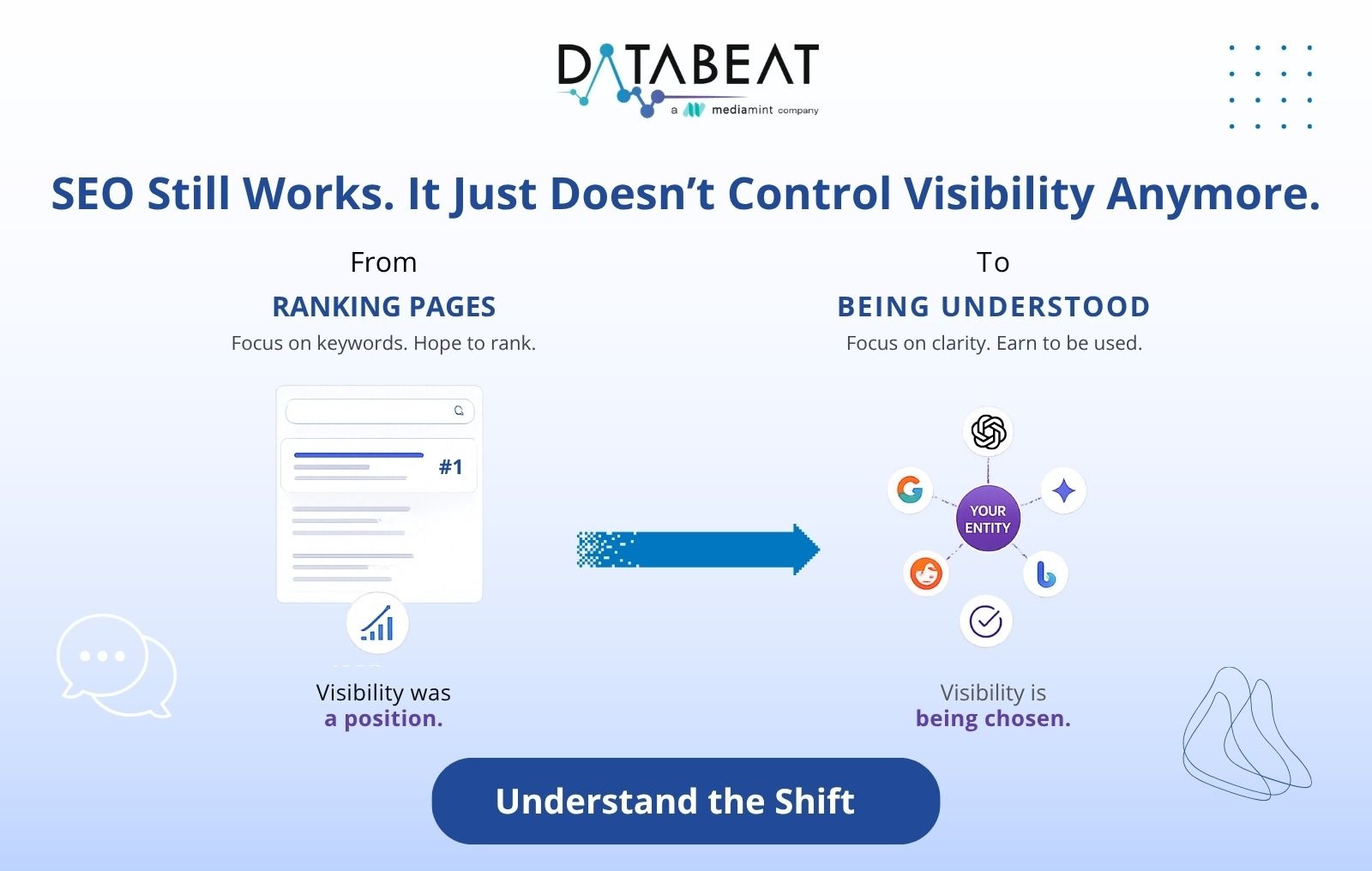
The real shift: from “ranking pages” to “being understood.”
If we have to reduce everything happening right now into one line, it would be this: we are moving from ranking documents to understanding entities.
That may sound abstract, but in practice, it changes almost everything.
Because now the system is asking: What is this entity? Is it consistent across the web? Do multiple sources agree on it? And can it be safely summarized?
And if the answers are unclear, you may not show up in many places, even if you technically rank somewhere.
What actually still works (and what people underestimate)
There is a convergence happening across SEO, AEO, and GEO that most teams still underestimate. It is not about technical tricks, but about informational quality.
What consistently works now is clarity over cleverness, because if something can be misinterpreted, systems will often avoid relying on it. Depth over volume also matters, since thin content does not just rank worse, it tends to get ignored more broadly across systems.
Entity consistency is another key factor, as inconsistent descriptions of a brand or concept across sources weaken trust signals. Cross-source reinforcement is increasingly important, too, since single-source claims are weak, while repeated independent validation carries more weight than many people assume.
So extractability is really important because if a system cannot easily summarize or reuse the content, it is less likely to show the content. This is not about doing things to get a better search ranking. It is just how modern systems that find and show information work, with the content.
The biggest strategic mistake we still see
One mistake many companies still make is treating discovery as separate tasks handled by different teams. People think of discovery as things that do not match up everywhere.
Companies are divided into teams. One team does the search engine optimization, another team makes the content, another team is in charge of branding and another team works on intelligence.
The people who are searching for information do not care about how the company is set up on the inside. To them, discovery is a single experience, and it needs to work smoothly and consistently across all platforms and channels.
They evaluate one thing: Is this information consistent, understandable, and reliable across contexts?
And that is a system-level property, not a page-level one. This is where most strategies quietly break, not in execution, but in fragmentation.
Where this actually leads
SEO is not going away. That is not the point.
The real shift is simpler: SEO used to be the center of visibility. Now it is part of a wider retrieval ecosystem. That ecosystem includes search, AI, social discovery, and generative synthesis.
So the question is no longer: “How do we rank?”
It is: “How do we remain reliably understood across systems we do not fully control?”
Final thoughts
If we strip away all the buzzwords, the planning model becomes surprisingly simple: stop optimizing only for pages and start optimizing for entities. Stop assuming ranking equals visibility, and stop assuming Google is the full distribution layer. And most importantly, stop treating SEO as the strategy. It is still necessary, but it is no longer sufficient.
How DataBeat helps
At DataBeat, the way we approach this is fairly straightforward. We do not treat SEO as the destination. We treat it as one signal inside a larger system.
What we actually try to improve is whether your content is semantically coherent across surfaces, whether your entity is consistently understood across the web, whether your information can be safely extracted and reused, and whether your content holds up in both ranking systems and generative systems.
The goal is not to replace SEO. It is to stop depending on it as the only visibility mechanism.
Because the real shift happening right now is not about search engines improving. It is about discovery itself becoming multi-system, multi-layered, and increasingly answer-driven.
And in that world, the winners will not just be the best ranked pages. They will be the most consistently understood sources.