The adtech industry is experiencing yet another period of change at the Structural Level. The increasing number of mergers, acquisitions, and strategic alliances is changing the competitive landscape within which companies within the advertising technology industry compete, the manner by which publishers monetise inventory, and the method by which advertisers allocate budgets on a global scale. The previously fragmented adtech marketplace, where there were many niche providers, is moving towards fewer, larger platforms offering more comprehensive, integrated solutions.
There are several forces driving the current consolidation in the advertising technology industry – in addition to the fact that larger platforms will be more cost-efficient due to economies of scale, there will also be regulatory pressures related to privacy and Data Access as they continue to have a growing impact on Cloud Services. These trends are likely to have an impact on where advertisers spend money and how both budget allocations will change, as well as how they plan to measure the success of their marketing campaigns.
Why Adtech Consolidation Is Accelerating
Typically, Adtech Consolidation will occur following a wide-scale disruption, as we currently have the benefit of numerous very strong catalysts. Combined with increasingly rising infrastructure costs and compliance costs, pressure on margins for intermediates, and the need for ongoing investment in AI, these challenges have made it extremely challenging for small and/or single-function vendors to survive independently in today’s market.
Furthermore, advertisers are now demanding fewer partners with the ability to deliver integrated purchasing efforts, measurement, and optimisation throughout channels, as well as regional borders. Through Mergers, vendors are able to integrate their complementary capabilities (eg, demand generation, supply, data, and analytics) into integrated platforms capable of addressing these evolving marketing requirements.
How Consolidation Affects Advertiser Global Spend
Budget Concentration
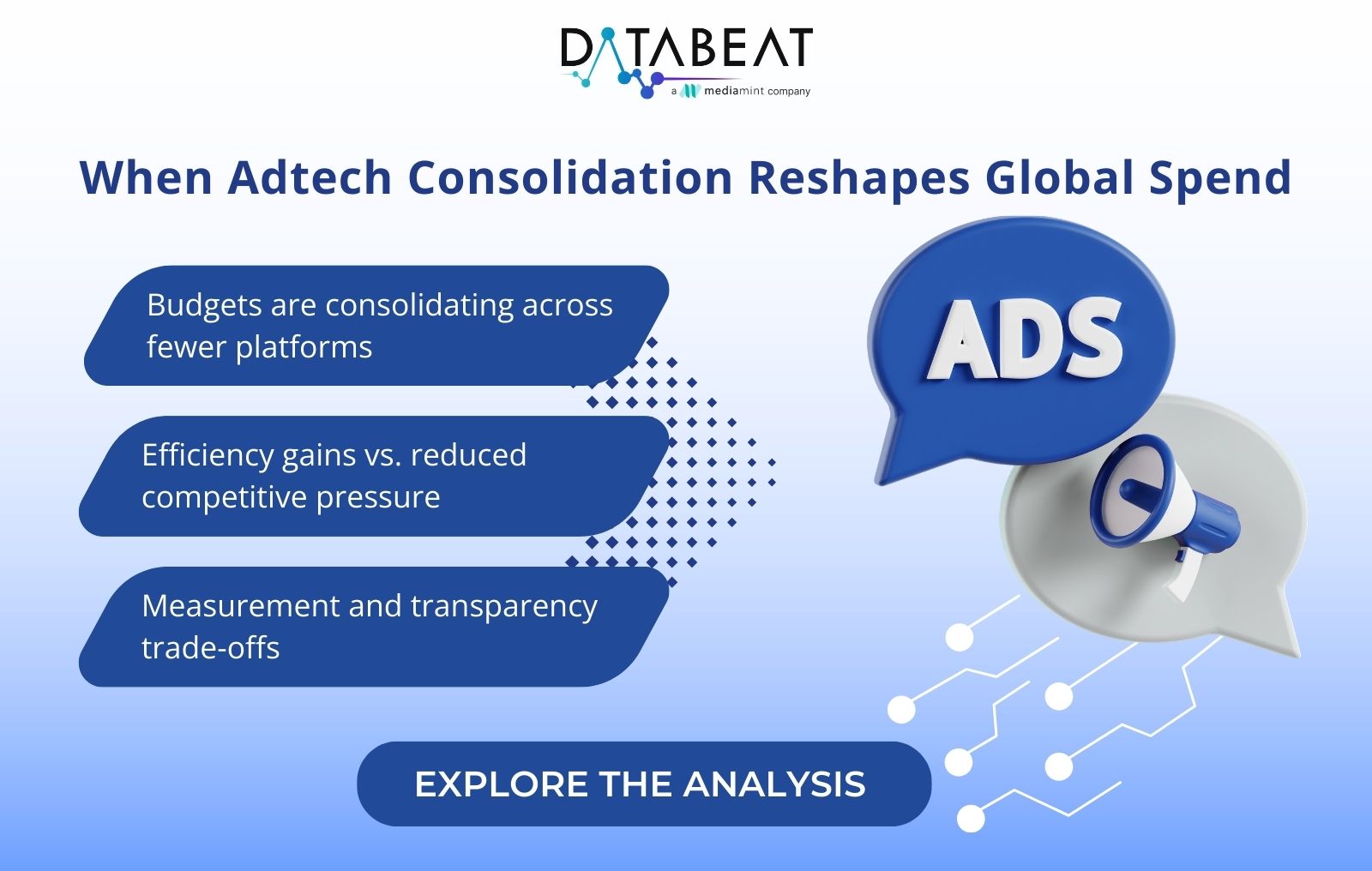
As platforms continue to grow through acquisition or merger, advertisers are choosing to consolidate budgets with fewer partners. With increased global spending moving toward vendors that can execute campaigns in multiple markets, have standard measures of success, and offer a centralized way to manage their campaigns, it has become easier for them to manage their day-to-day operations. However, this also presents the risk of not being able to diversify their advertising efforts.
Efficiency Versus Competition
For advertisers, short-term benefits may arise from consolidating vendors to take advantage of lower overhead through automation and bundled services. Over the long term, as competition decreases, advertisers will likely have less pricing pressure on their vendors and fewer innovative vendors and therefore will have less leverage with those vendors.
Measurement and Transparency Trade-Offs
Although consolidated platforms offer strong internal measurement systems, the ability to compare performance across multiple platforms is typically weaker. Therefore, advertisers can gain convenience through consolidation but may lose independent benchmarks, particularly when executing a global campaign.
Competition in a Consolidated Market
The consolidation of markets does not mean that there will be no more competition; instead, it will change how companies view competition. Instead of companies competing against one another based on an isolated product versus product feature-by-feature basis, they will now be competing with each other based on the overall strength of their ecosystem (data access, identity coverage, AI optimization capabilities, etc.) and their overall compliance ability to comply with the law.
The Role of AI in Market Consolidation
AI acts as a competitive advantage and creates a significant economic impact on the efficiency of marketing. AI-based decision-making in regard to product targeting, product distribution, and forecasting has historically been concentrated in the hands of those operating under the umbrella of one of the major scaled platforms. This has increased the rate of market consolidation. In addition, the implementation of more advanced AI-based products, such as those in the area of optimization, will continue to create an economic impact on the way companies allocate their budgets on a global basis.
Implications for Publishers
The publisher level exists in the middle of the two competing trends. Prepping for the future, as demand continues to consolidate, it will become easier for publishers to access and work with their largest customers. Digital marketplaces will become increasingly reliant on a smaller number of digital marketplaces. Publishers that use first-party data and have access to a premium inventory and an identified different audience can take advantage of their bargaining position if they are able to access a number of different demand sources.
What Advertisers Need to Consider
Whether or not it creates economies of scale, consolidation presents risks. Issues such as not being able to freely move vendors, a lack of visibility of company data, a growing regulatory scrutiny, and the reliance on proprietary measurement systems are all considerations that advertisers globally need to evaluate when developing their advertising expenditure consolidation strategies.
To offset the risk of consolidation, advertisers are increasingly diversifying their expenditures across key media platforms and select independent media companies, making investments in independent measurement and clean room technology, and evaluating prospective partners on the basis of long-term interoperability rather than just the short-term return on investment (ROI) of their advertising campaigns.
Conclusion
Mergers and restructuring in the adtech market have changed how companies view competitiveness. This shift is evident in how they plan and spend their advertising budgets. Consolidation has led to both cost savings and efficiency, along with shifts in power, price, and transparency in the company-client relationship. Advertisers must understand how these changes can affect their influence and flexibility in the long run. Responding thoughtfully to the consolidation process will be crucial for managing global advertising spending in an increasingly consolidated adtech industry.
How DataBeat Helps
DataBeat helps advertisers and publishers make sense of an increasingly consolidated adtech landscape. We analyze spend distribution, platform performance, and measurement gaps across regions, enabling informed partner and budget decisions. Our strength lies in data engineering and a deep understanding of advertiser and publisher workflows, helping teams navigate consolidation with clarity and control.