New data from Ozone confirms what many in the ad industry have been seeing: fewer ads are being served across the open web.
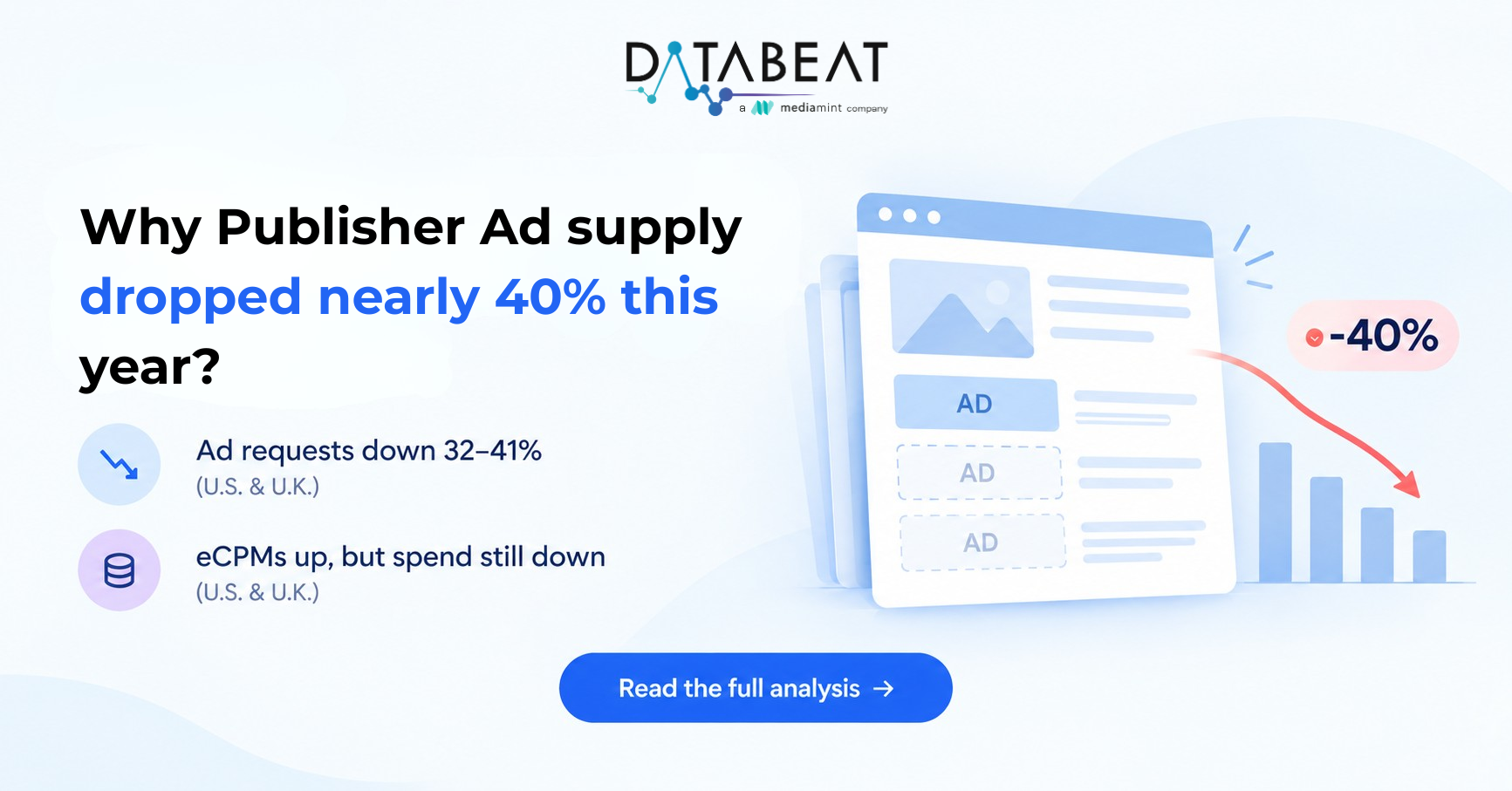
Ozone analyzed around 20 billion ad impressions on publisher sites in the US and UK Between April and June 2026, ad requests in the US declined by 32 – 37% year over year. In the UK, the drop was even bigger, at 39 – 41%.
The main reason is simple. AI search tools and “zero-click” results now answer people’s questions directly on the search page. People get what they need without clicking through to a website. And if nobody visits the page, there’s no pageview and no ad gets shown. Trace it back far enough, and that’s where these declining volume numbers come from.
Spend didn’t fall as fast as supply did
Here’s the part that complicates the story: even with supply down by roughly a third to two-fifths, overall programmatic spend in Ozone’s tracked cohort fell by a smaller 30.6% across the first half of 2026.
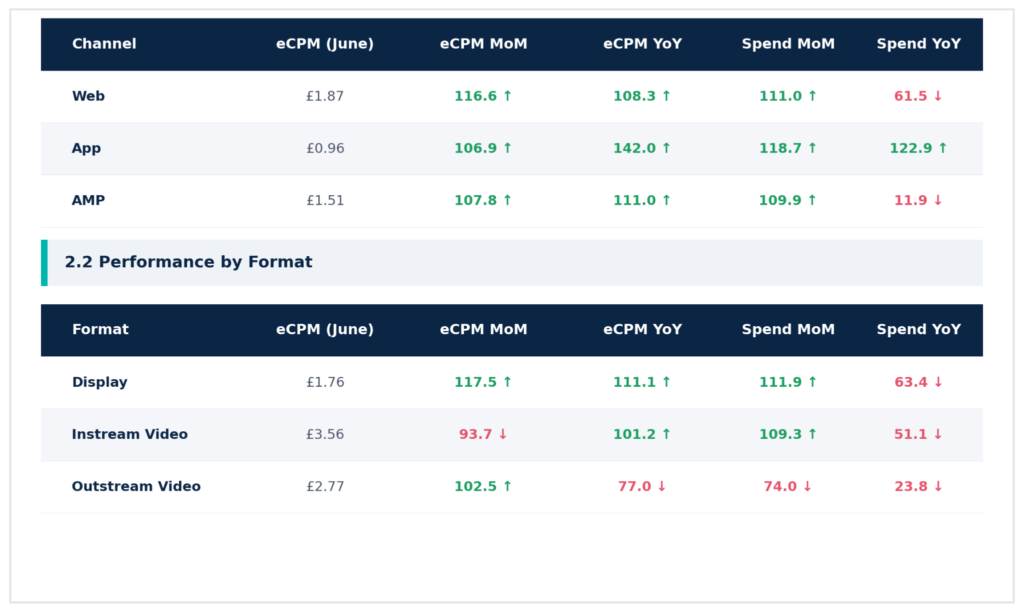
Price is narrowing the gap between the two. eCPMs rose sharply in both markets, particularly in the UK, where they increased around 30% year over year in June, compared with roughly 7% in the US That’s also why UK spent fared much better, falling 14.3% compared with a 44% decline in the US
Industry voices see the rise in eCPMs as a sign that buyers are still willing to pay for publisher inventory. With fewer ad opportunities available, the remaining inventory is becoming more expensive.
But higher prices haven’t made up for the drop in volume. Programmatic spend across Ozone’s US and UK publisher cohort was still down 30.6% in the first half of 2026.
Why the US and UK are moving at different speeds :
The US has a much larger open web, with a wider range of inventory. That could be one reason eCPMs are rising more slowly there than in the UK Some industry observers expect the US to see a similar shift over time.
Traffic loss isn’t the only factor. Some publishers are also cutting back on ad loads and removing bid requests that bring little value. They’re looking to get more out of the inventory they have, rather than simply serving more ads.
Scarcity has a ceiling, but nobody knows where
The question is how long publishers can keep earning more per impression as the number of available impressions falls.
TV is a useful comparison here. Ad prices have kept going up even as audiences have shrunk. But the open web has a different problem. If advertisers can’t measure performance well or get the audience data they need, they may put that money into platforms where they have more visibility into results.
There’s also a bigger shift behind the decline. People are finding answers through AI search without visiting publisher sites, while much of the time spent on social platforms stays within the feed. Neither necessarily brings people to an open-web page where an ad can be served.
As these habits change, publishers have fewer opportunities to show ads. Higher eCPMs are helping make the remaining inventory more valuable, but they don’t replace the impressions that are no longer there.
A broader reassessment of “infinite supply” :
Some in the industry see this moment as the end of an assumption the adtech industry has operated on for roughly 15 years: that publisher inventory is effectively limitless and programmatic pricing can always find more of it.
AI-driven traffic declines are forcing the industry to reconsider that assumption and rethink strategies built around ever-expanding volume rather than durable value.
Publishers are investing more in the parts of their businesses they can still control directly, including subscriptions, apps, newsletters, and logged-in environments where discovery and monetization aren’t as dependent on search engines.
They’re also raising the bar for what counts as premium inventory. Publishers that can demonstrate value through first-party data, attention metrics, or proven context are becoming more attractive than those relying on domain reputation alone.
Channel-level cracks and a geopolitical wildcard :
Not every format is shrinking at the same rate.
In June, app ad spend in the US was up around 23% year over year, with eCPMs rising 42%. Web spend, by contrast, rebounded slightly month over month but remained roughly 38.5% below year-ago levels.
Within the sample, display drove most of the recovery, while out-stream video continued to slide, down around 76% year over year.
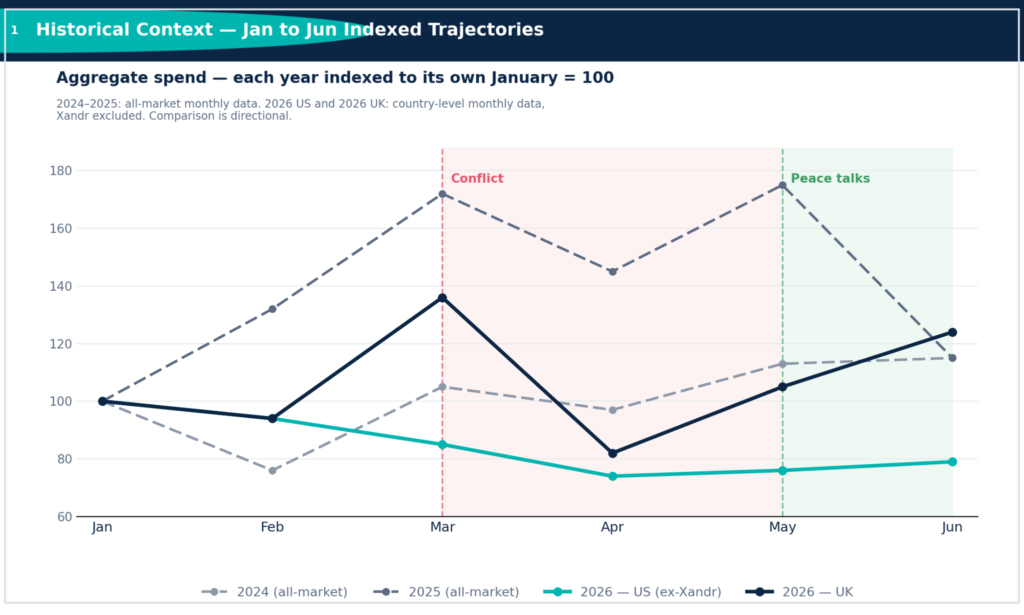
Layered on top of the AI search story is a separate, geography-specific shock. The US-Iran conflict, which began in late February, appears to have disrupted the usual seasonal pattern of US programmatic spending. Spend dipped and hadn’t returned to its January baseline by May, a pattern that the UK didn’t share.
Certain US-exposed categories, such as B2B tech and betting and gaming, pulled back sharply. Meanwhile, more domestically focused categories, including FMCG (fast-moving consumer goods) and retail fashion, continued to grow.
This suggests that the pullback may have reflected broader economic uncertainty rather than a general loss of appetite for advertising.
A market resetting, not recovering :
Taken together, the picture looks less like a temporary downturn and more like a structural reset. Supply is shrinking because content discovery is moving away from the open web, not necessarily because publishers are producing less or worse content. Publishers with subscription revenue and strong app businesses appear better positioned to absorb the shift. Those still heavily dependent on open-web, ad-supported pageviews are more exposed. As one industry voice put it, the market appears to be finding a new equilibrium, albeit a particularly volatile one to navigate.