Digital marketing is changing quickly due to the decline of third-party cookies. This decline has pushed advertisers to create new strategies for reaching targeted customers while also respecting consumers’ privacy. Advertisers used to rely on third-party cookies to track individual consumers’ activity across different sites. This allowed them to show targeted ads based on that activity on multiple websites.
Advertisers are now utilizing several methods to gather first-party data and a combination of data cleaning processes and identities verification methods to create other ways to connect with their target audience. While none of these alternatives can completely replace third-party cookies, they provide advertisers with more sustainable options to reach their advertising goals while still addressing the increased consumer demand for protections of personal data, compliance with existing privacy regulations for data, and support of consumer privacy.
The Decline of the Third-Party Cookie
The ability for advertisers and publishers to track users through third-party cookies across websites they did not own provided a powerful method of targeting but also created a lot of invisibility. As governments introduce new digital marketing regulations, such as GDPR and CCPA, and as consumer attitudes about privacy evolve, more and more browsers – including most recently Safari and Firefox – have ceased support for third-party cookies.
This deprecation makes things much harder. The conventional perspective on the customer journey becomes disjointed in the absence of a universal identifier, complicating attribution, frequency management, and measurement across the open web.
The Rise of First-Party Data as the New Foundation
First-party data is the most valuable and long-lasting asset in digital advertising. It is information that is collected directly from the user through owned channels with their permission to use it. It includes:
- Activity on websites and apps
- Sign-ups for newsletters and CRM data
- History of purchases
- Answers to the survey
- Details about your registered account
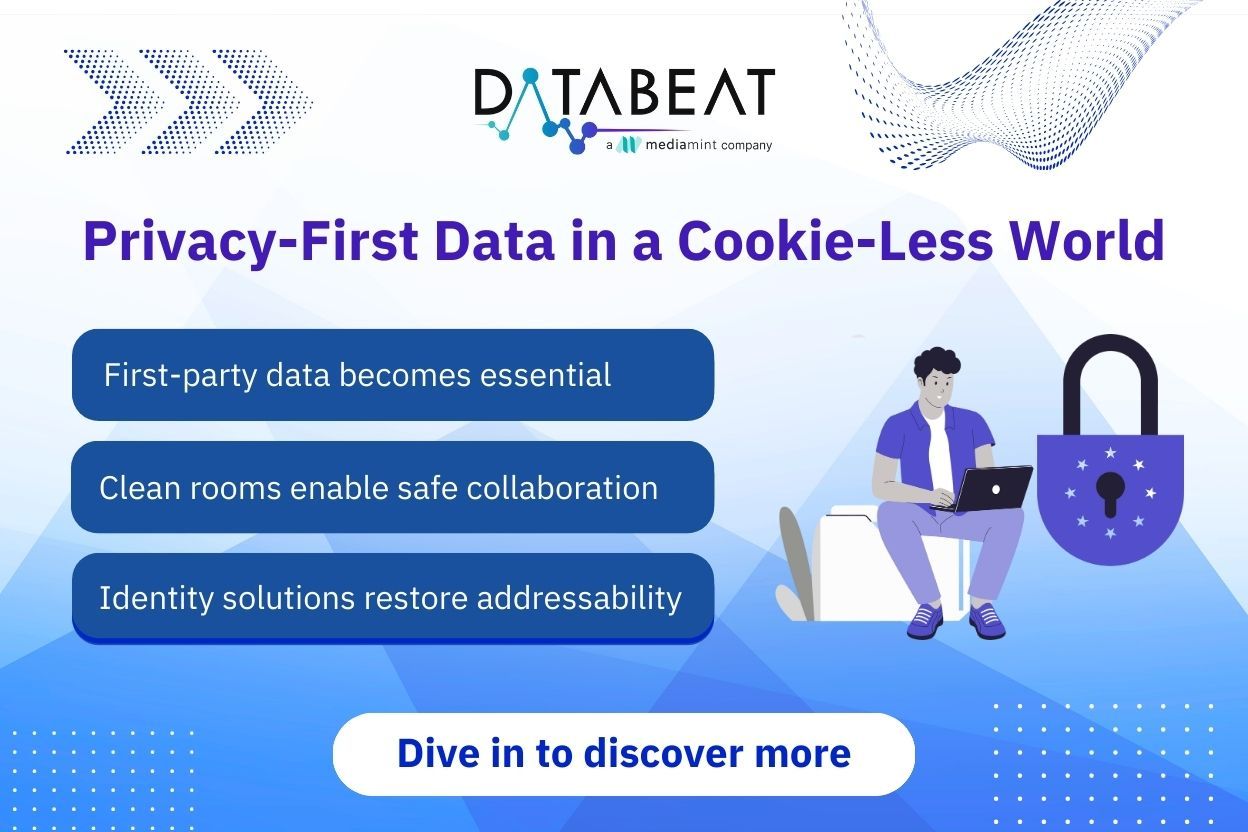
Digital advertising will continue to exist, even though there will be a decrease in the use of third-party cookies. However, this transition signifies an evolution in the focus of digital advertising towards privacy. The current trend is focused on using clean rooms, identity solutions, and using first-party data.
Clean Rooms: Enabling Collaboration Without Compromise
Data clean rooms help with this problem. These safe places let different people look at datasets that are similar without having to share raw, user-level information. Encryption, aggregation, and strict query controls protect privacy while also allowing insights.
Some common uses are:
- Audience overlap and growth: Finding common audiences and making lookalike segments that are safe for privacy
- Measuring the campaign: Looking at performance or conversion lift without giving out PII
- Attribution: Knowing how one partner affects another while keeping data separate
Identity Solutions: The Connective Tissue
Identity frameworks are often used in clean rooms and first-party strategies to match users across datasets without giving away personal information. These solutions use agreed-upon signals to make pseudonymous identifiers that protect privacy. Some common methods are:
- Hashed email identifiers: Making hashed versions of emails that people have agreed to share so that they can be matched safely
- Universal IDs: Standalone identity systems that create permanent IDs from verified signals.
No one identity solution has become a universal standard yet, but these frameworks are trying to bring back addressability and measurement in a world without cookies, as long as transparency and consent stay important.
Balancing Personalization and Privacy
A major conflict in this shift is striking a balance between responsibility and relevance. Customers still want individual experiences but they also want transparency and control over the use of their data. As a result, several best practices are gaining traction:
- Clear consent and disclosure mechanisms
- Purpose-limited data usage
- Greater reliance on contextual and intent-based signals
- Aggregation and modeling over individual-level tracking
What This Means for Publishers
This change offers publishers both opportunities and challenges. Important factors include:
- Investing in first-party data collection and management infrastructure
- Selecting identity solutions that are in line with audience scale and trust
- Working together in clean rooms while maintaining data control
- Reevaluating measurement techniques that go beyond deterministic attribution
Publishers who take a deliberate, measured approach will be better positioned to sustain monetization as privacy expectations continue to evolve.
Conclusion
The way publishers/advertisers communicate through their website interactions being straightforward, informative and based on user consent, in conjunction with creating direct relationships with their audience through having secure methods of data sharing, will lead to greater success on behalf of those publishers and advertisers. Additionally, the changes made to the digital advertising ecosystem will contribute to long-term success by improving trust among advertisers, publishers, and audiences, as well as encouraging compliance with the law.
How Databeat Helps
Databeat supports publishers as they adapt to a privacy-first data ecosystem by focusing on practical execution rather than theoretical solutions. We help teams structure and activate first-party data, integrate clean room workflows into existing analytics and ad stacks, and evaluate identity solutions in the context of real publisher operations. By combining data engineering expertise with a strong understanding of publisher workflows, Databeat enables partners to test, measure, and refine privacy-safe data strategies that align with both compliance requirements and monetization goals.