In recent years, chatbots have become popular for helping people find products, make purchases, and interact with businesses. As more opportunities to use this technology appear, publishers are beginning to explore whether chatbots can become a meaningful source of revenue. The rise of advanced conversational tools like ChatGPT, Gemini, and Claude has brought new engagement models into the mainstream. This makes it natural for publishers and advertisers to ask whether conversations themselves can be monetized.
The question remains: can chatbots deliver real revenue or will this trend fade like so many others in ad tech?
The Rise of Conversational Interfaces
Chatbots have grown rapidly across retail, media, and service applications. A report from Juniper Research predicts that chatbots will drive more than seventy-two billion dollars in global e-commerce spending by 2028, up from less than five billion in 2023. This growth matters because it shows where user intent is shifting. If more commerce begins to flow through conversational interfaces, publishers who are facing flat or declining display revenue have an opportunity to tap into a new layer of intent-rich engagement.
As chat interfaces become part of everyday digital experiences, publishers are beginning to view this interaction layer not only as a UX improvement but also as a potential new advertising format.
How Conversational Monetization Works
Conversational monetization is built on a simple idea: people engage with sponsored messages when they appear inside useful and relevant dialogue. Instead of relying only on video or display ads, publishers can introduce sponsored content or product recommendations inside AI-generated responses.
For example, if a user asks a chatbot, “What is a good running shoe for beginners?” The system can offer organic suggestions and also include a sponsored line such as, “You can also explore the new Nike Pegasus 41, available now.”
Over time, this can grow into a new ad experience that blends intent, context, and engagement.
Why Publishers Are Paying Attention
Traditional ad formats such as display, video, and native have reached a point of maturity. Privacy laws are tightening. Third-party cookies are disappearing. Tracking audiences has become more difficult. For these reasons, contextual and engagement-based formats are gaining relevance.
Perplexity has introduced a program that shares revenue with publishing partners such as Time, Der Spiegel, Fortune, Entrepreneur, The Texas Tribune, and Automattic. Publishers earn a share of ad revenue when Perplexity surfaces their content in response to user queries. Open AI, Microsoft, and Perplexity are also testing sponsored or promoted answers, suggesting that conversational ads may grow into a significant revenue channel across AI platforms.
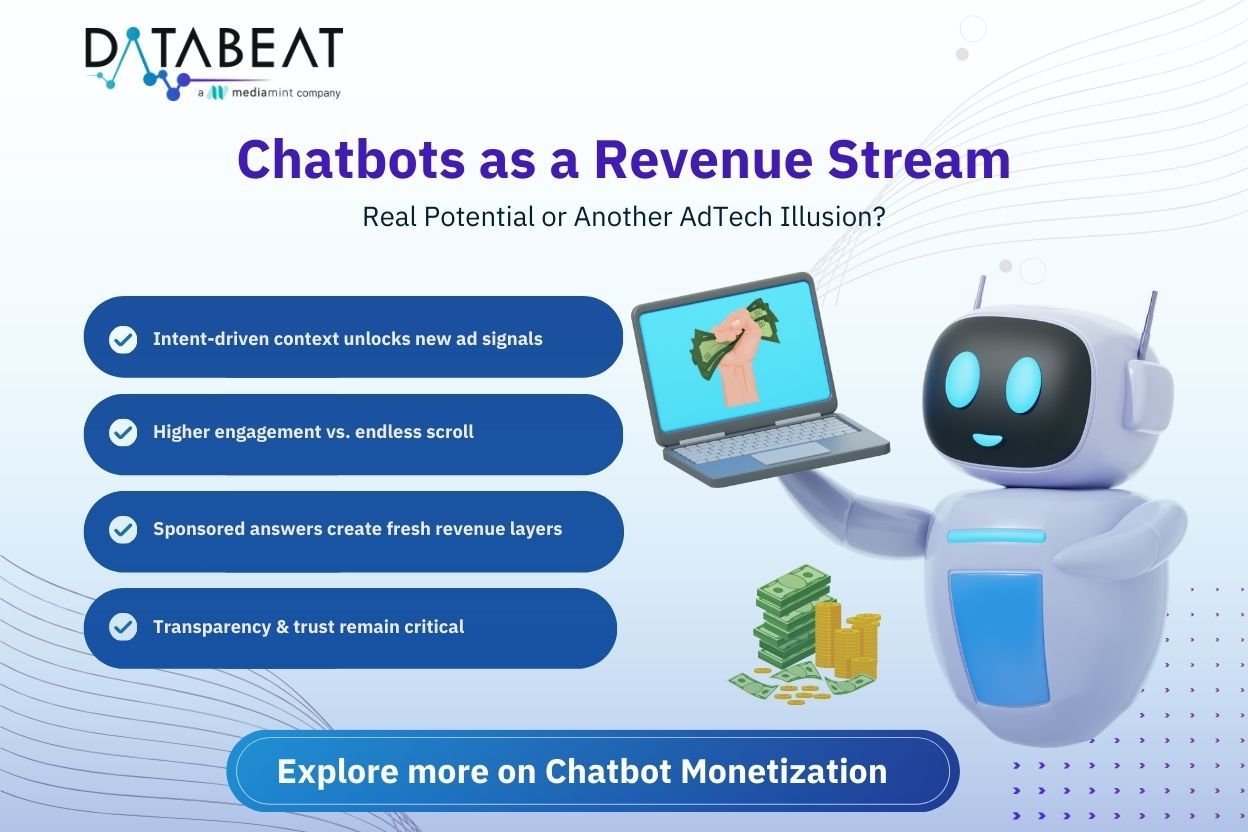
Chatbots provide four key benefits for publishers:
- Intent-driven context: Each exchange reveals what the user wants in the moment, giving advertisers valuable signals.
- Higher engagement: Users respond and ask follow-up questions instead of scrolling endlessly. This leads to deeper sessions and stronger ad recall.
- A new revenue layer: Publishers who already offer AI chat experiences can introduce sponsored responses or affiliate-based recommendations without cluttering their platforms.
- Enhanced first-party signals: Chat interactions give publishers additional insight into user preferences and interests, within the boundaries of privacy regulation.
Challenges and Ethical Boundaries
The opportunity is promising, yet it brings clear challenges.
- Transparency: Users should know when a message is sponsored. If paid suggestions blend too closely with helpful advice, trust erodes quickly.
- Measurement complexity: Most legacy metrics do not fit multi-turn conversations. Clicks and impressions cannot show whether a question was answered, whether the user was satisfied, or whether a sponsored suggestion had influence. Publishers will need new signals such as conversation depth, intent completion, satisfaction ratings, and ad recall metrics.
- Data privacy: Chatbots process natural language input, which can include sensitive information. Publishers need strong processes to ensure compliance with GDPR, CCPA, and other regulations when experimenting with monetization.
Are Chatbots the Future of Publisher Revenue
Skeptics compare conversational ads to earlier ad tech experiments that did not scale, such as voice assistant ads or metaverse inventory. They question whether users will trust a format where commercial messages appear within answers that feel personal and helpful.
Advocates see chatbots as an emerging interface in the attention economy. Every interaction is personalized, conversational, and measurable. As AI improves at understanding language and sentiment, targeting may shift from broad audience attributes to real-time conversational context.
If built with transparency and care, conversational advertising can balance utility and monetization in a way that benefits both users and publishers.
A Measured Path Forward
The strongest opportunities will come from controlled and thoughtful experimentation. Publishers and platforms should:
- Develop transparent labeling: Use clear “Sponsored” indicators and provide opt-out options.
- Establish governance rules: Define policies for when sponsored content appears, how it is disclosed, how sensitive topics are handled, and how issues are escalated.
- Pilot sponsored conversations: Test monetization within narrow use cases such as product discovery or content recommendations.
- Revise engagement metrics: Move beyond clicks to measure conversational satisfaction, intent completion, and brand recall.
- Ensure brand safety and relevance: Ads should be contextually appropriate and avoid interrupting the experience.
Conclusion
Chatbots deserve close attention because early experiments show real potential when executed responsibly. The format is still developing, and publishers will play a central role in defining its standards. The future of this revenue opportunity depends on whether the industry builds with clarity, usefulness, and trust. If it does, chatbots may become a viable and valuable revenue stream for publishers.
How Databeat Will Help
DataBeat supports publishers in exploring conversational monetization through a clear and structured approach. Our core capabilities include system integration, data engineering, and a strong understanding of publisher workflows. We help teams convert conversational data into usable formats, integrate chatbot experiences with existing advertising and content systems, and test sponsored response formats through real operational processes. Our goal is to help publishers determine whether conversational formats can deliver meaningful and sustainable revenue.